
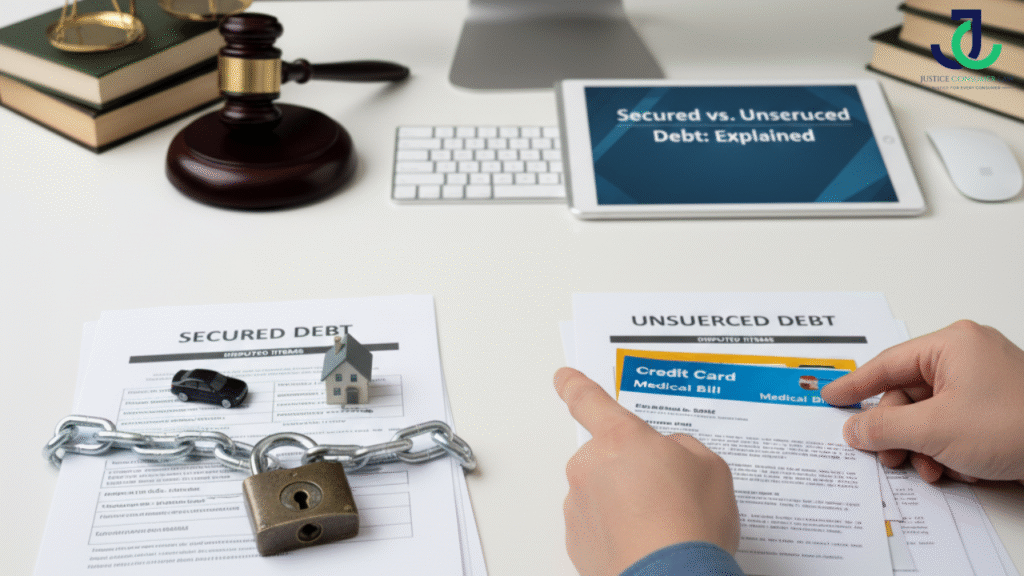
Secured vs. Unsecured Debt (explained)
Secured vs. Unsecured Debt Chicago | Illinois Debt Lawyer Explains the Difference
Confused about secured vs unsecured debt? Understanding the difference is critical when dealing with creditors, considering bankruptcy, or facing collections in Illinois.
Justice Consumer Law helps Chicago residents understand their debt types and legal rights. Our Illinois debt attorneys explain how secured and unsecured debt are treated differently under the law and protect your rights when creditors violate collection rules.
Why Understanding Debt Types Matters
Secured and unsecured debt are treated completely differently under Illinois law, in bankruptcy, and during collections. Knowing which debts are secured versus unsecured affects:
- What property you can lose to creditors
- Which debts get paid first in bankruptcy
- Your negotiation leverage with creditors
- Whether collectors can seize assets
- Priority during debt settlement
- Legal defenses available to you
Our Chicago debt lawyers help Illinois residents understand their debt classification and enforce their rights under federal and state consumer protection laws.
What Is Secured Debt?
Secured debt is backed by collateral, meaning the lender can take a specific asset if you fail to make payments.
How secured debt works:
When you take a secured loan, you give the creditor a security interest (lien) in property. If you default, the secured creditor has legal right to take that specific property through repossession or foreclosure, even without suing you first in many cases.
Key characteristics of secured debt:
Collateral Backing: Specific property secures the debt (car, house, equipment)
Lower Interest Rates: Because creditors have collateral protection, secured loans typically have lower rates than unsecured debt
Repossession Rights: Secured creditors can take collateral without going to court in Illinois (though some procedures must be followed)
Survives Bankruptcy: In Chapter 7 bankruptcy, you must either pay secured debt or surrender the collateral debt isn’t automatically eliminated
Priority Status: Secured creditors get paid before unsecured creditors from collateral sale proceeds
Common Examples of Secured Debt
Mortgages: Your home secures the loan. If you default, the lender forecloses through Illinois judicial process.
Auto Loans: Your vehicle secures the debt. Lenders can repossess your car after default with proper notice under Illinois law.
Home Equity Loans/HELOCs: Your home secures the credit line as a second mortgage with foreclosure rights.
Title Loans: Vehicle title secures short-term loans. Lenders can repossess immediately upon default.
Equipment Financing: Business equipment secures the loan with repossession rights.
Judgment Liens: After winning a lawsuit, creditors can place liens on your Illinois property, converting unsecured debt to secured.
What Is Unsecured Debt?
How unsecured debt works:
With unsecured debt, you promise to repay but don’t pledge specific property. If you default, the creditor must sue you in Illinois court, win a judgment, and then use legal collection methods like wage garnishment or bank levies.
Key characteristics of unsecured debt:
No Collateral: No specific property backs the debt
Higher Interest Rates: Without collateral protection, unsecured creditors charge higher interest to offset risk
Must Sue to Collect: Cannot seize property without first winning a lawsuit and obtaining judgment
Dischargeable in Bankruptcy: Most unsecured debt is completely eliminated in Chapter 7 bankruptcy with no payment required
Lower Priority: Unsecured creditors get paid last, after secured creditors and priority debts
Common Examples of Unsecured Debt
Credit Cards: Most common unsecured debt. Issuers must sue to collect unpaid balances.
Medical Bills: Hospital and provider debts are unsecured. Must sue to collect from Illinois patients.
Unpaid medical bills can also move into collections, so it is important to understand how medical debt can affect your credit and when reporting or collection errors can be disputed.
Personal Loans: Bank loans without collateral, including signature loans and installment loans.
Student Loans: Federal and private student loans are unsecured but have special collection powers and bankruptcy protections.
Utility Bills: Electric, gas, and water bills are unsecured. Providers can disconnect service but must sue for past-due amounts.
Payday Loans: Most are unsecured, though lenders may have ACH access to your bank account.
Past-Due Rent: Landlords must sue for unpaid rent in Illinois; they cannot seize personal property.
Key Differences: Secured vs. Unsecured Debt
Collection Rights: Secured creditors can repossess collateral with minimal court involvement. Unsecured creditors must file lawsuits, win judgments, and use legal collection tools.
Interest Rates: Secured debt has lower rates (mortgages 3-7%, auto loans 4-12%). Unsecured debt has higher rates (credit cards 15-30%, personal loans 10-36%).
Bankruptcy Treatment: Most unsecured debt is discharged in Chapter 7. Secured debt requires payment, surrender, or redemption. In Chapter 13, secured debt must be paid fully; unsecured debt often receives partial or no payment.
Negotiation Leverage: More leverage exists with unsecured debt because creditors have no collateral. Secured creditors have less incentive to negotiate.
Deficiency Rights: After repossessing collateral, secured creditors can sue for deficiency balances if the sale doesn’t cover the debt, converting the deficiency to unsecured debt.
Priority Debt: A Third Category
Some debts are priority unsecured debts—they have no collateral but receive special treatment:
Child Support and Alimony: Cannot be discharged in bankruptcy; collected through wage garnishment and license suspension in Illinois.
Recent Taxes: Recent federal and state income taxes (typically last 3 years) are priority debts.
Wages Owed to Employees: If you’re a business owner, employee wages are priority debts.
Priority debts must be paid in full in Chapter 13 bankruptcy and are not dischargeable in Chapter 7.
How Secured and Unsecured Debt Are Collected in Illinois
Secured Debt Collection
Repossession (Personal Property): Illinois secured creditors can repossess vehicles and equipment without court orders if they don’t breach the peace. They must provide proper notice under Illinois law.
Foreclosure (Real Estate): Mortgage lenders must file foreclosure lawsuits in Cook County Circuit Court or other Illinois courts—a judicial process taking 7-12 months.
Deficiency Balances: After repossession or foreclosure, if the collateral sale doesn’t cover your debt, the secured creditor can sue you for the remaining deficiency balance. This converts the deficiency into an unsecured judgment debt in Illinois.
Unsecured Debt Collection
Collection Attempts: Unsecured creditors send letters and make calls following consumer protection rules before suing.
Lawsuit Required: To collect unsecured debt, creditors must sue in Illinois court and obtain a judgment.
Post-Judgment Collection: After winning, creditors can garnish wages (up to 15% in Illinois for consumer debts), levy bank accounts, or place liens on property.
Our Chicago debt defense attorneys defend collection lawsuits and sue collectors violating consumer protection rules.
Secured vs. Unsecured Debt in Bankruptcy
Chapter 7 Bankruptcy
Secured Debt: You have three options: (1) reaffirm the debt—sign a new agreement to keep paying and keep the collateral, (2) surrender the collateral and discharge any deficiency, or (3) redeem—pay the current market value in a lump sum to keep the property. Without action, the secured creditor can repossess after bankruptcy.
Unsecured Debt: Completely discharged with no payment required. Credit cards, medical bills, and personal loans are eliminated.
Chapter 13 Bankruptcy
Secured Debt: Must be paid in full through your 3-5 year plan if you keep the collateral. Mortgage arrears can be caught up over the plan. For vehicles, Chapter 13 cramdown may allow you to reduce the loan to the car’s current value if the loan is over 910 days old.
Unsecured Debt: Paid based on disposable income after secured and priority debts. Many Illinois Chapter 13 filers pay 0-30% of unsecured debt; the rest is discharged.
Our Illinois bankruptcy attorneys explain how debt classification affects your bankruptcy strategy and savings.
When Unsecured Debt Becomes Secured
Judgment Liens: After winning lawsuits, unsecured creditors can record judgment liens against your Illinois real estate, converting unsecured debt to secured. These liens must be satisfied before you can sell or refinance.
Voluntary Security Agreements: Settlement agreements may require granting security interests, converting previously unsecured debt to secured.
Tax Liens: IRS and Illinois Department of Revenue can place tax liens on property without suing first, converting tax debt to secured status.
Understanding these conversions protects Chicago residents from losing property to former unsecured creditors.
Consumer Protection Rights Against Debt Collectors
Secured creditors must follow Illinois repossession laws, no breach of peace, proper notice, commercially reasonable collateral sales, and proper procedures for deficiency lawsuits.
Unsecured debt collectors must comply with strict consumer protection rules including call time limits (8am-9pm), workplace contact restrictions, harassment prohibitions, truthful representations, debt validation requirements, and limited third-party contact.
Our Chicago consumer protection attorneys sue collectors violating consumer protection and recover $1,000 statutory damages per violation plus actual damages and attorney fees.
Why Choose Justice Consumer Law
Consumer Protection Specialization
We focus exclusively on consumer protection law including debt defense, consumer protection violations, and credit reporting issues in Illinois.
Zero Out-of-Pocket Costs
When we sue debt collectors for consumer protection violations, federal law requires them to pay our attorney fees. You never pay out of pocket.
Proven Results
Our attorneys have defended hundreds of debt collection lawsuits, recovered damages from consumer protection violations, and helped Chicago residents understand their debt rights.
Litigation Experience
We handle cases in Cook County Circuit Court, DuPage County, Lake County, Will County and throughout Illinois.
Client Success Stories
“Justice Consumer Law explained which of my debts were secured versus unsecured. This helped me make the right bankruptcy decision, keeping my car while eliminating $40,000 in credit card debt.” — Patricia L., Chicago
“A debt collector was threatening to take my car for an unsecured credit card debt. Justice Consumer Law explained they couldn’t do that and sued them for consumer protection violations. I received a settlement.” — Marcus D., Naperville
“Understanding secured vs unsecured debt helped me negotiate better. I settled my unsecured debts for 40 cents on the dollar while keeping my home.” — Linda K., Aurora
Our Debt Consultation Process
Step 1: Free consultation—review all your debts and classify as secured, unsecured, or priority
Step 2: Explain how each debt type affects you legally
Step 3: Identify violations by collectors or creditors
Step 4: Recommend strategy: negotiation, bankruptcy, litigation, or defense
Step 5: Implement solution protecting your rights and property
Posted on GoogleTrustindex verifies that the original source of the review is Google. I called them because I was so sick of getting back to back phone calls from a collection company. They settled my case fast and I couldn’t be happier!Posted on GoogleTrustindex verifies that the original source of the review is Google. Finding Justice Law was a huge relief. From the very first call to the final settlement, the entire legal team was incredibly helpful and professional. They made the whole process smooth and stress free, and throughout the case, they kept me informed and supported every step of the way. If you are looking for a team that will guide you through the legal process with transparency, respect, and real dedication, i highly recommend Justice Law.Posted on GoogleTrustindex verifies that the original source of the review is Google. Justice Consumer Law group done an excellent job for me with my case. I am extremely grateful for their help and patience.Posted on GoogleTrustindex verifies that the original source of the review is Google. The absolute best team to help with your case!Posted on GoogleTrustindex verifies that the original source of the review is Google. Thank you Justicw Consumer for helping me with my case! Your team was professional and resolved my issue faster than I expected. I can never thank you enough! I will recommend Justice Consumer Law Firm to everyone I know.Posted on GoogleTrustindex verifies that the original source of the review is Google. I received a high level of care from the agents of the agency. I felt like they went above and beyond for me.Posted on GoogleTrustindex verifies that the original source of the review is Google. I am incredibly satisfied with the staff that helped. Knowledgeable and responsive!
Take Control Today
Don’t let inaccuracies damage your financial future. Act quickly to protect and restore your credit health.
Frequently Asked Questions
Secured debt is backed by collateral the creditor can repossess if you don't pay. Unsecured debt has no collateral, creditors must sue and obtain judgments to collect.
Not directly. Unsecured creditors must sue, obtain a judgment, then use legal collection methods like wage garnishment or bank levies. They cannot repossess property without court involvement.
In Chapter 7, you must reaffirm and keep paying, surrender the collateral, or redeem by paying market value. In Chapter 13, secured debt is paid through your plan. Secured debt isn't discharged if you keep the collateral.
Most unsecured debt is completely discharged in Chapter 7. In Chapter 13, you pay what you can afford over 3-5 years; remaining unsecured debt is discharged.
No. Credit cards are unsecured debt. The issuer must sue and obtain a judgment before any collection. They cannot repossess property.
After secured creditors repossess and sell collateral, if the sale doesn't cover your debt, the remaining balance is the deficiency. Creditors can sue you for this amount in Illinois, converting it to unsecured debt.
Yes. After winning lawsuits, unsecured creditors can record judgment liens against your Illinois real estate, giving them secured interest in that property.
Reaffirmation is a new agreement with secured creditors in Chapter 7 bankruptcy where you agree to keep paying the debt to keep the collateral. It makes you personally liable again for debt that would otherwise be discharged.