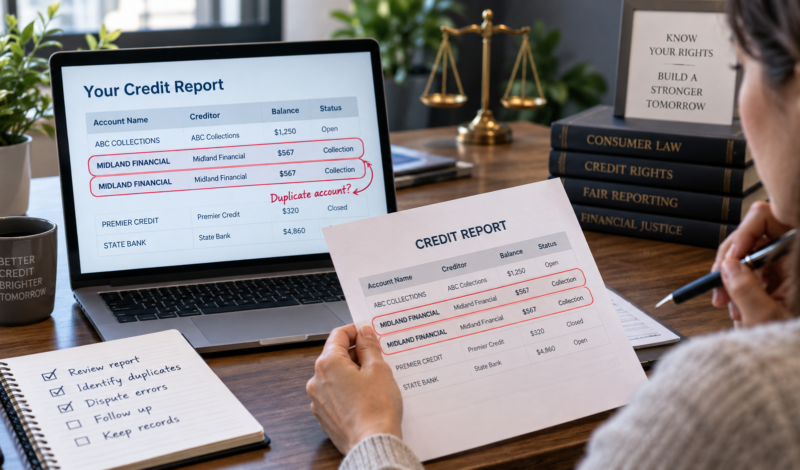

If the same debt listed multiple times on your credit report makes it look as though you owe several separate obligations, the first step is to identify exactly how each entry is being reported. The Consumer Financial Protection Bureau lists the same debt appearing more than once, sometimes under different names, as a common credit-report error.
At Justice Consumer Law, we focus on whether the entries are accurate, complete, and capable of misleading someone reviewing your file. You do not need to guess which line to challenge. You can compare the account numbers, balances, dates, creditor names, collection-agency names, and status information, then dispute the inaccurate or duplicative reporting with the credit bureau and the company furnishing the data.
Why the Same Debt Can Appear More Than Once
A credit report can show both an original account and a collection account connected to the same underlying obligation. That does not automatically mean the report is inaccurate. The key question is whether the entries truthfully describe what happened, identify the correct parties, and avoid creating a false impression about the amount or number of debts you owe.
Look for duplication, not just similar names
Start by placing the entries side by side. Compare the creditor or collector name, partial account number, original creditor, balance, date opened, date of first delinquency, and current status. If two entries appear to represent the same obligation but both show a current balance that makes it appear you owe twice as much, that is a specific issue worth documenting. Our page on credit reporting issues and FCRA legal help explains how inaccurate credit information can be disputed.
A collection transfer can create confusing reporting
Debt accounts can move from an original creditor to a collection agency or debt buyer. A name change alone is not proof of an error. What matters is whether each tradeline accurately reflects who owns or services the debt and whether the balances and statuses are consistent with the underlying account history.
What a mixed file can look like
Sometimes the real problem is not duplication at all. Information belonging to another person can appear in your file, especially when names, addresses, or other identifiers overlap. We discuss that separate problem in our guide to mixed credit files.
How to Dispute Duplicate Debt Reporting
The Fair Credit Reporting Act gives you a process for disputing information you believe is inaccurate or incomplete. A strong dispute is specific. Instead of saying only that an account is wrong, identify the exact entries, explain why they represent the same debt or why a balance or status is inaccurate, and include documents that support your position.
Get copies of the reports showing the problem
Save the version of each credit report that contains the disputed entries. The three nationwide bureaus may not display the same data in the same way, so check each report separately. Mark the exact tradelines and preserve the date you obtained each report.
Dispute with the credit bureau and the furnisher
The CFPB recommends disputing inaccurate information with both the credit reporting company and the company that supplied the information. In your written dispute, identify the account, explain the duplication, state what you believe should be corrected or deleted, and attach copies rather than originals of supporting records. Keep a complete copy of what you send.
Create proof of what you sent
Keep the dispute letter, attachments, delivery confirmation, screenshots from any online portal, and every response. That record can become important if the disputed information remains, changes only temporarily, or later reappears.

What to Check After the Investigation
Do not assume the issue is resolved because you received a generic investigation result. Pull or review the updated report and compare each disputed field. Check the balance, status, dates, account ownership, and whether the duplicate entry actually disappeared.
Watch for deletion followed by reinsertion
If information was deleted after a dispute and later reinserted, the FCRA has specific reinsertion requirements. A credit reporting agency generally cannot reinsert deleted information unless the furnisher certifies that it is complete and accurate, and the agency must provide notice of the reinsertion.
Document any real-world harm
If the inaccurate duplication affects a credit application, housing application, insurance decision, interest rate, or another transaction, save the notice or correspondence showing what happened. A clean timeline connecting the reporting problem to the consequence can matter when we evaluate a credit-reporting dispute.
When We Review Repeated Credit Reporting Errors
At Justice Consumer Law, we look closely at what was reported, what you disputed, what supporting information you provided, and how the bureau or furnisher responded. Our credit-report error and identity-theft page explains the type of credit-reporting problems we handle. If a duplicate account remains after a documented dispute, or if deleted information returns, you can request a free case review so we can examine the facts without assuming that every duplicate-looking entry is automatically unlawful.
Build the record before requesting a review
Bring the reports showing the duplicate entries, your dispute letters, proof of delivery, investigation results, and any denial or adverse-action notices. Those documents let us evaluate the reporting history instead of relying on memory alone.
Conclusion
Removing the same debt listed multiple times starts with precision. Identify the entries, compare the data, dispute the specific inaccuracy, and preserve every response. If the reporting still makes one obligation look like several or the error keeps returning, Justice Consumer Law can review the dispute history and help you understand the next available step. This information is general and not legal advice; rights depend on the facts and applicable law.
Frequently Asked Questions
These common questions can help you organize the issue before you decide what to do next.
Does seeing an original creditor and a collection agency always mean the debt is duplicated?
No. Two entries can relate to the same underlying debt without automatically being inaccurate. Review who owns or services the account, each balance, and each status before deciding what is actually wrong.
Should I dispute duplicate reporting with only the credit bureau?
The CFPB recommends disputing inaccurate information with both the credit reporting company and the furnisher that supplied the information.
What documents should I attach to a duplicate-debt dispute?
Use documents that directly support the correction you are requesting, such as account statements, payoff records, settlement records, creditor correspondence, or prior investigation results.
What if the duplicate entry disappears and later comes back?
Preserve the before-and-after reports and any notices you receive. Reinsertion after deletion is governed by specific FCRA requirements and should be reviewed carefully.
Can a duplicate debt be caused by someone else’s account appearing on my file?
Yes, in some situations. If the account is not yours at all, the issue may involve a mixed file or identity theft rather than duplicate reporting of your own debt.
When should I contact Justice Consumer Law?
Consider a free case review when a documented inaccuracy remains after disputes, returns after deletion, or causes a concrete credit, housing, employment, or other consumer-report problem.