
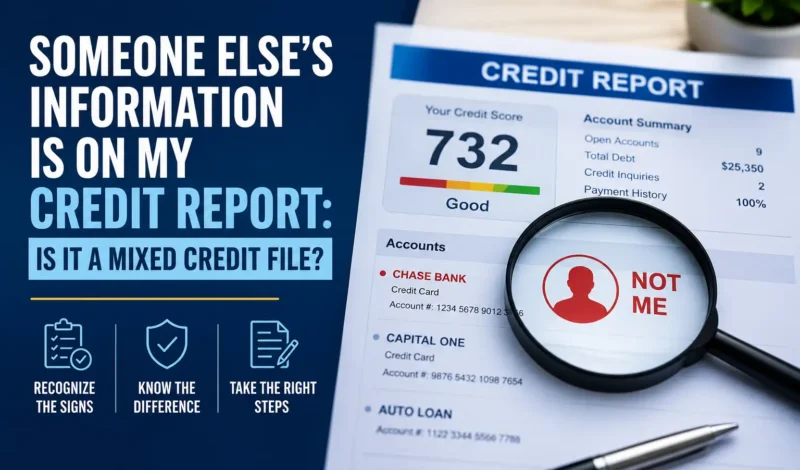

Finding accounts, addresses, debts, or other information belonging to someone else on your credit report can be alarming. One possible explanation is a mixed credit file, which occurs when a credit reporting company combines information belonging to two different consumers into the same file.
The Consumer Financial Protection Bureau identifies accounts belonging to someone with the same or a similar name as a common credit reporting error and specifically describes the mixing of two consumers’ information in one file as a mixed file. But another person’s information appearing on your report does not automatically prove that a mixed file occurred. Identity theft, inaccurate information from a furnisher, or another reporting problem could also be responsible.
How a Mixed Credit File Happens and What You Can Do About It
A mixed credit file happens when information associated with another consumer becomes connected to your credit file.
For example, imagine two people have the same first and last name. One has a delinquent credit account. If a consumer reporting agency incorrectly matches that account to the other person’s file, the second person’s report may contain a debt that does not belong to them.
The problem is fundamentally one of identity matching and credit report accuracy.
Under the Fair Credit Reporting Act, or FCRA, consumer reporting agencies preparing consumer reports must follow reasonable procedures designed to assure the maximum possible accuracy of information concerning the individual whose report is being prepared.
The CFPB has specifically warned that matching information to a consumer based only on the person’s first and last name is not sufficient to satisfy this accuracy obligation. Other identifying information, such as addresses, dates of birth, or Social Security numbers, may be relevant when determining whether information actually belongs to a particular consumer.
What Are the Signs That Your Credit File May Be Mixed?
The strongest warning sign is information that clearly belongs to another person.
When reviewing your credit reports, look for issues such as:
- Accounts you never opened
- Names or name variations that are not yours
- Addresses where you never lived
- Loans or credit cards belonging to another person
- Account histories that do not match your financial activity
- Information associated with someone who has a similar name
The CFPB specifically advises consumers to check whether their reports contain accounts belonging to another person with the same or a similar name.
One incorrect address by itself may not establish that your entire file has been mixed. A pattern is more concerning. For example, an unfamiliar address appearing alongside an unfamiliar credit account may provide more context than either error viewed separately.
Is a Mixed Credit File the Same as Identity Theft?

No. A mixed file and identity theft can produce similar symptoms, but the underlying problems are different.
With a mixed file, another person’s legitimate information may have been incorrectly associated with you because of a matching or data problem.
With identity theft, someone may actually have used your identity to open an account or conduct transactions.
The CFPB lists both mixed files and accounts resulting from identity theft as separate types of identity-related credit report errors.
That distinction matters because the appropriate response may depend on why the inaccurate information appeared.
If the unfamiliar account belongs to another real consumer, the issue may involve inaccurate matching. If someone opened an account using your identity, you may be dealing with identity theft instead.
Why Can Mixed Files Happen?
Consumer reporting systems process large amounts of information from different sources. Problems can arise when information is matched to the wrong person.
Names alone can be particularly unreliable identifiers because many people share identical or similar names.
The CFPB has stated that name-only matching creates substantial accuracy concerns. Its guidance explains that consumer reporting agencies cannot satisfy the FCRA’s maximum possible accuracy requirement simply by matching information to someone because the person’s name looks similar.
That does not mean every mixed file proves an FCRA violation. Whether legal obligations were violated depends on the particular facts, the procedures used, the information reported, and what happened after the consumer challenged the error.
What Should You Do If Someone Else’s Information Appears on Your Report?
Start by reviewing the inaccurate information carefully.
Identify exactly what does not belong to you rather than sending a vague statement that your credit report is wrong. Relevant details may include the unfamiliar account, address, balance, account number, or other identifying information appearing on the report.
The CFPB recommends contacting both the credit reporting company that provided the report and the company that furnished the disputed information when inaccurate or incomplete information appears.
Keep copies of the credit report and the information you submit with the dispute. Clear documentation can make it easier to identify exactly which information you challenged and how the credit reporting agency responded.
What Must a Credit Reporting Agency Do After You Dispute the Information?
Under the FCRA, when a consumer directly disputes the completeness or accuracy of information in their file, a consumer reporting agency generally must conduct a reasonable reinvestigation free of charge.
The statute generally provides a 30-day reinvestigation period beginning when the agency receives notice of the dispute. In specified circumstances, that period may be extended by up to 15 additional days if the agency receives relevant additional information from the consumer during the initial period.
The agency must also review and consider the relevant information submitted by the consumer.
If the reinvestigation determines that information is inaccurate, incomplete, or cannot be verified, the FCRA requires the agency to delete or appropriately modify the disputed information. The consumer reporting agency must also provide written notice of the results after completing the reinvestigation.
What If the Other Person’s Information Keeps Coming Back?
A recurring error deserves particular attention. The FCRA requires consumer reporting agencies to maintain reasonable procedures designed to prevent information deleted after a dispute from improperly reappearing in a consumer’s file, subject to the statute’s reinsertion rules.
If another person’s account is removed and then later appears again, keep the earlier dispute, the investigation result, the updated report, and the later report showing the information’s return.
A history of what happened can be important when evaluating whether the problem was properly investigated and corrected.
When Should You Consider Talking to a Consumer Protection Attorney?
Consider legal review when another person’s information remains on your credit report after you have clearly disputed it, repeatedly returns after correction, or creates a significant problem that remains unresolved.
At Justice Consumer Law, we handle credit reporting issues and help consumers understand potential rights under the FCRA. The firm provides assistance with credit report errors and disputes and offers a free case review for consumers seeking to understand their options.
Whether a particular mixed-file problem creates a legal claim depends on the facts. Important questions may include what information was reported, whether it actually belonged to another person, what identifying information was available, how you disputed it, and what happened during the reinvestigation.
If someone else’s financial history is being reported as yours, the first objective is to identify the source of the error and create a clear record of the dispute.
Frequently Asked Questions
What does a mixed credit file mean?
A mixed credit file means information belonging to two different consumers has been combined in one consumer’s credit file. The CFPB identifies this as a type of credit reporting error.
Can having the same name as someone else cause a mixed file?
It can contribute to the problem. The CFPB has specifically warned that matching consumer information based only on identical or similar names does not satisfy the FCRA’s requirement for reasonable procedures designed to assure maximum possible accuracy.
Does an unfamiliar account automatically mean identity theft?
No. An unfamiliar account may result from identity theft, a mixed file, or another reporting error. Determining why the account appears is important before deciding how to address it.
How long does a credit bureau generally have to investigate a dispute?
The FCRA generally requires the reinvestigation to be completed within 30 days after the consumer reporting agency receives the dispute, although an extension of up to 15 additional days can apply in certain circumstances.
Can I get legal help if a mixed file is not corrected?
Potentially. If inaccurate information remains after a dispute or repeatedly returns, a consumer protection attorney can evaluate the circumstances and determine whether the FCRA or another applicable law may provide options.