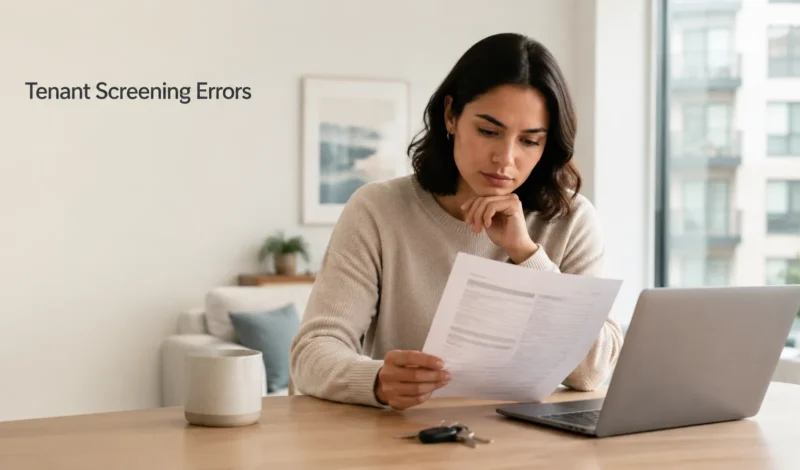

RentGrow tenant screening errors are at the center of a federal enforcement action involving a $2.25 million civil penalty judgment and an injunction. On August 12, 2026, the U.S. Department of Justice announced that a federal court had entered a stipulated order resolving allegations that RentGrow violated the Fair Credit Reporting Act (FCRA) and the FTC Act. The allegations involved report accuracy, disclosure of information and sources, dispute procedures, and statements made to consumers after successful disputes.
This action matters because a tenant screening report can determine whether a person is approved, denied, charged a larger deposit, or required to find a cosigner. Applicants should review the report used against them instead of assuming every criminal or eviction entry is correct.
What Happened in the RentGrow Case?
The federal court entered an order requiring RentGrow Inc. to pay a $2.25 million civil penalty and follow an injunction addressing its tenant screening practices. RentGrow supplies background reports that landlords and property managers use when evaluating rental applicants.
According to the Justice Department’s announcement, the order resolves government allegations; it does not mean that every RentGrow report contained an error. Each renter must examine the report prepared about them and the decision connected to it.
The order also requires compliance reporting, monitoring, and recordkeeping. It addresses procedures for duplicate records, consumer disclosures, disputes, and statements about whether corrections reached a housing provider.
What Did the DOJ and FTC Allege RentGrow Did Wrong?
The government’s complaint focused on three connected parts of the tenant screening process: accuracy, transparency, and reinvestigation of disputes.
Duplicate Criminal and Eviction Records

The government alleged that RentGrow failed to use reasonable procedures to prevent the same criminal or eviction proceeding from appearing more than once. A single case could appear as several entries because separate events within that case were displayed as if they were different proceedings.
One eviction case displayed several times can make a person appear to have faced several evictions. Duplicate criminal entries can similarly make a record seem more extensive. The FTC’s RentGrow case summary says the alleged practices sometimes overstated applicants’ criminal convictions or eviction actions.
Incomplete Disclosure of Report Information and Sources
The complaint also alleged that RentGrow did not always disclose all report information and its sources when consumers requested their files. The FTC specifically identified LexisNexis Accurint as an alleged undisclosed source of certain historical addresses and middle names used in matching records.
Source disclosure helps a renter trace an error and show that a record belongs to someone else, relies on an old address, contains a mismatched name, or describes a court case incorrectly.
Problems With Consumer Disputes and Correction Notices
Federal agencies further alleged that RentGrow failed to follow required procedures for some disputes, including disputes involving duplicate records or court records updated after the original screening date. The complaint alleged that certain disputes were labeled “invalid” without the action required under the FCRA.
The government also alleged that some consumers were told a successful correction had been reported to the housing provider while the provider was told there had been no change. A correction has limited value if the decision-maker does not receive it.
Why Can a Tenant Screening Error Cause Serious Harm?
A tenant screening error can block housing when information is inaccurate, incomplete, outdated, duplicated, sealed, expunged, or associated with another person. Common errors include mixed files, missing case outcomes, duplicate cases, and legally outdated information.

A negative decision, also called an adverse action, is not limited to a complete denial. It can include:
- Rejecting the rental application
- Requiring a cosigner or guarantor
- Charging a larger security deposit
- Charging higher rent or imposing another unfavorable condition
These outcomes can cause lost fees, temporary housing expenses, moving costs, or the loss of a suitable home. Proof of these consequences may become important evidence.
What FCRA Rights Do Rental Applicants Have?
The Fair Credit Reporting Act treats tenant background reports as consumer reports. It requires covered reporting agencies to follow accuracy, disclosure, and dispute-investigation duties. Our background check errors page explains related consumer-reporting problems.
If a landlord takes an adverse action based partly or entirely on a screening report, the renter must receive an adverse action notice. That notice must identify the screening company and explain the renter’s right to dispute inaccurate information and request a free copy of the report within 60 days.
The screening company generally has 30 days to investigate a dispute, although some investigations may take up to 45 days. The FTC’s tenant-screening guidance explains these rights in more detail.
An adverse action notice does not prove a violation. It identifies the reporting company and helps the applicant inspect the report and challenge errors.
What Should You Do if a RentGrow Report Affected Your Rental Application?
Take organized action as soon as you learn that a RentGrow report influenced a housing decision:
- Get the adverse action notice. Ask the landlord or property manager for written notice if the decision was communicated orally. Keep the email, letter, portal message, or screenshot.
- Request your RentGrow report. Use the contact information in the notice and request the free report within 60 days. Also ask the landlord which entry, score, or recommendation affected the decision.
- Review every identifying detail and public record. Check names, middle names, birth information, addresses, criminal cases, eviction proceedings, case numbers, filing dates, outcomes, and repeated entries.
- Dispute errors in writing. Clearly identify each inaccurate or incomplete item, explain the correction requested, and attach supporting records. Send copies rather than original documents and retain proof of delivery.
- Notify the housing provider. Tell the landlord or property manager that the report is disputed. Provide reliable supporting documents and ask whether the application can be reconsidered or held open while the investigation proceeds.
- Preserve the complete timeline. Keep the original report, revised report, dispute letters, results, housing advertisements, receipts, and communications. Record the date of each application, decision, dispute, correction, and rental loss.
The CFPB’s rental-application guidance likewise recommends obtaining the report and disputing inaccurate or outdated entries.
Does the $2.25 Million Order Automatically Compensate Renters?
No. The $2.25 million judgment is a civil penalty payable under the federal order, not an automatic compensation fund for every person screened by RentGrow. The order also does not establish that every report was inaccurate or that every applicant has a private claim.
An individual case depends on the specific report, procedures used, dispute history, housing decision, resulting harm, and applicable filing deadlines. A renter may have legal options when inaccurate reporting or an unreasonable investigation causes harm, but those options require a fact-specific review.
When Should You Speak With a Consumer Protection Attorney?
Consider a legal review when a background-check error affected housing, a documented dispute was not properly investigated, corrected information was not communicated, or inaccurate data continued to appear. Seek guidance promptly if you lost housing, paid more, or suffered other measurable harm.
Justice Consumer Law helps consumers evaluate credit and background-reporting problems under the FCRA. We can review the tenant screening report, adverse action notice, dispute correspondence, investigation results, and evidence of damages to determine which parties and legal rules may apply.
Contact Justice Consumer Law for a free consultation.
This article provides general information and is not legal advice. The RentGrow order resolves government allegations, and every potential claim depends on its own facts and deadlines.