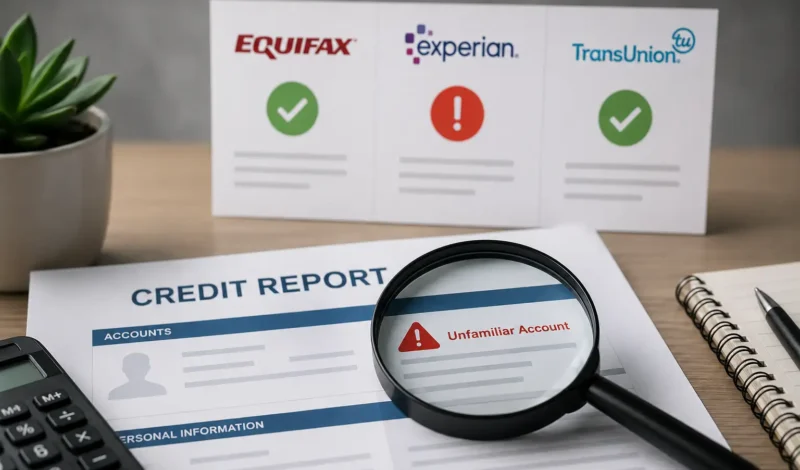

A credit report error can appear with only one credit bureau because Equifax, Experian, and TransUnion do not necessarily receive, match, process, or update exactly the same information at the same time. Finding an error on one report while the other two look correct does not make the error less important. It may actually help identify where the inaccurate information entered the reporting system.
The Federal Trade Commission explains that each nationwide credit bureau receives information from different sources, so one bureau’s report may not be completely identical to the reports maintained by the other two. The Consumer Financial Protection Bureau also recognizes that credit reporting companies gather information from furnishers such as banks, landlords, credit card issuers, and other businesses.
Why the Same Credit Information Does Not Always Appear at Equifax, Experian, and TransUnion
Credit reports from Equifax, Experian, and TransUnion can differ because each bureau maintains its own consumer file and may receive information from different furnishers at different times. A creditor may report an account to one bureau but not the others, or information may be updated on different schedules. Errors can also arise from how a bureau matches information to a consumer or processes data it receives. That is why an error appearing on only one credit report should be reviewed on its own. Comparing all three reports helps identify where the discrepancy exists and what information may require a dispute.
Do All Three Credit Bureaus Have the Same Information?
No. Your three credit reports can contain different information.
Equifax, Experian, and TransUnion are separate consumer reporting agencies. They maintain their own consumer files based on information they receive. The FTC specifically notes that because the bureaus obtain information from different sources, information contained in one report may differ from information in another.
This distinction is important when investigating an error.
Suppose Experian reports an account as delinquent while the same account is shown correctly at Equifax and TransUnion. The difference does not automatically tell you who caused the problem. It does tell you that you need to investigate what Experian is reporting and compare it with the underlying account information.
A one-bureau discrepancy may provide a narrower starting point than an error appearing across all three files.
Can a Creditor Report Information to Only One Credit Bureau?
Creditors and other furnishers do not necessarily provide information to every nationwide credit reporting agency.
The FTC has explained that not all creditors report information to all three bureaus. Creditors may also report information on different days. This naturally creates differences among consumer files.
The CFPB has documented the same issue in the debt collection context, noting that some debt collectors do not furnish information to every nationwide credit reporting company.
Consider an account for which a lender supplies information only to TransUnion. If the information being supplied is inaccurate, the problem might initially appear only on the TransUnion report because Equifax and Experian never received that particular information.
That is why comparing all three reports matters. The question is not simply, “Is this account wrong?” You also want to know where the inaccurate information appears.
Could the Error Come From the Credit Bureau Instead of the Creditor?

Potentially. A credit reporting problem can involve the information supplied by a furnisher, how information is associated with a consumer’s file, or how the consumer reporting agency handles disputed information.
The CFPB identifies several types of credit reporting errors. These include incorrect names or addresses, accounts belonging to someone with the same or a similar name, accounts incorrectly reported as delinquent, inaccurate balances, duplicate debts, and accounts resulting from identity theft.
If only one bureau displays the incorrect information, you should not automatically assume the lender caused the error merely because the other two reports are accurate.
Instead, compare the incorrect entry with the corresponding information on the other reports and with your own records.
Look at the creditor or furnisher name, account number, account status, balance, payment history, dates, ownership status, and any identifying information connected with the disputed item. That comparison can help define exactly what you need to dispute.
Does an Error on Only One Report Still Matter Under the FCRA?
Yes. An inaccuracy does not have to appear on all three reports before you can dispute it.
The Fair Credit Reporting Act, or FCRA, provides a process for disputing the completeness or accuracy of information contained in a consumer’s file.
When a consumer directly notifies a consumer reporting agency of a qualifying dispute, the agency generally must conduct a reasonable reinvestigation free of charge. The statute generally requires completion within 30 days after the agency receives the dispute, although certain circumstances can extend that period.
The agency must also review and consider relevant information submitted by the consumer. If the reinvestigation determines that the disputed item is inaccurate, incomplete, or cannot be verified, the FCRA requires the agency to delete or appropriately modify the information.
The important point is that the obligation relates to the information contained in that consumer reporting agency’s file. The other two bureaus do not need to contain the same mistake for the dispute to matter.
Should You Dispute an Error With Only the Bureau That Shows It?
If the inaccurate information appears on only one report, the CFPB recommends disputing inaccurate information with the credit reporting company that provided the report and with the company that furnished the information.
Your dispute should identify what is wrong, explain why you believe it is inaccurate, and include relevant supporting documents.
For example, if TransUnion shows a late payment that does not appear on Equifax or Experian and your account records support your position, your dispute should clearly identify that specific payment history rather than simply stating that your credit report contains errors.
The CFPB also recommends disputing inaccurate information with the furnisher. When a furnisher determines that it provided incorrect information, it must update or remove that information and notify the credit reporting companies after correcting it.
This is also why keeping your dispute focused matters. A precise dispute gives the bureau and furnisher a clearer factual issue to investigate.
Why Should You Check the Other Two Reports Before Filing a Dispute?
Comparing the three reports helps establish the scope of the problem.
If only one bureau contains the inaccurate account status, the problem may be limited to that reporting channel or file. If all three contain the same inaccurate information, the common source of the data may require closer attention.
The comparison can also reveal that the problem is broader than you initially thought. One bureau might show an incorrect balance, another might report an inaccurate payment status, and the third might contain a related identifying error.
The FTC currently states that consumers can obtain reports from each of the three nationwide bureaus through AnnualCreditReport.com and that the bureaus have continued a program allowing consumers to check each report weekly for free.
Do not assume that a clean report from one bureau proves the other report is wrong. Use account statements, payment records, correspondence, identity documents, or other relevant evidence to determine what the correct information should be.
What If the One-Bureau Error Is Not Corrected After You Dispute It?
An unresolved dispute deserves closer review, particularly when you provided documentation identifying a specific error.
Under the FCRA, a consumer reporting agency conducting a reinvestigation must consider relevant information submitted by the consumer. It must also provide written notice of the results after completing the reinvestigation.
A furnisher also has responsibilities when a dispute reaches it through a credit reporting company, including investigating the disputed information and reporting its results back to the reporting company.
If the information remains after your dispute, preserve your original credit report, dispute correspondence, supporting documents, investigation results, and subsequent reports. Those records can help establish what you reported and what happened afterward.
At Justice Consumer Law, we help consumers address credit reporting problems and understand their rights under the FCRA. Our credit-related practice includes inaccurate information and credit report disputes.
Whether an unresolved credit report error creates a legal claim depends on the specific facts. An attorney can review where the error appeared, who supplied the information, what you disputed, what evidence you submitted, and how the bureau and furnisher responded.
Frequently Asked Questions
Why is an account showing on Experian but not Equifax or TransUnion?
The bureaus do not necessarily receive identical information. Each bureau can obtain information from different sources, and creditors do not necessarily report every account to all three nationwide bureaus.
Does one correct credit report mean the other bureau’s information must be wrong?
No. Differences between reports are not automatically errors. You need to compare the disputed information with your actual account records and other reliable documentation.
Can I dispute an error if it appears on only one credit report?
Yes. Consumers have the right to dispute inaccurate information and are recommended to dispute it with the credit reporting company showing the error and the furnisher that supplied it.
How long does a credit bureau generally have to investigate?
A credit reporting agency generally has 30 days after receiving a qualifying dispute to conduct its reinvestigation. Certain circumstances can extend the period.
Should I keep copies of all three reports?
Keeping the reports can help document which bureau reported the disputed information and whether the same information appeared elsewhere. Supporting records are also useful when explaining precisely why information is inaccurate.