
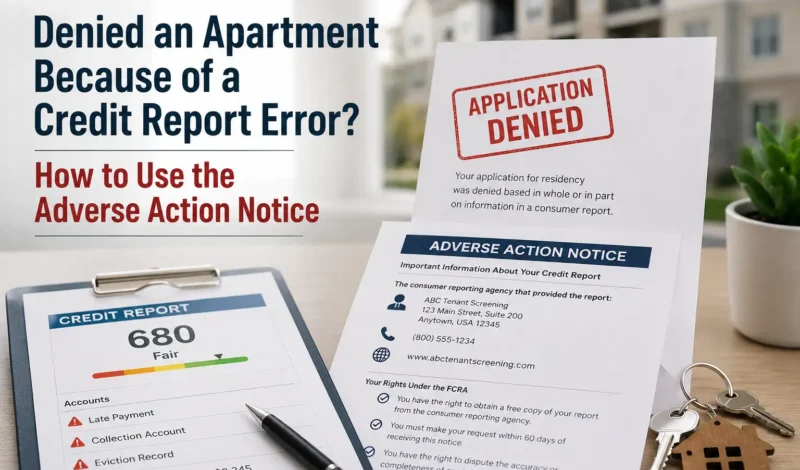

If you were denied an apartment because of information in a credit report or tenant screening report, the adverse action notice can help you identify what happened and where to start challenging an error. Under the Fair Credit Reporting Act, or FCRA, a landlord who takes adverse action based in whole or in part on information from a consumer report must notify you and provide information about the reporting company that supplied the report.
Do not treat the notice as just a rejection letter. It can point you to the exact consumer reporting company whose information affected the rental decision and give you a route to obtain and review the report for inaccurate information.
How to Use an Adverse Action Notice After an Apartment Denial
An adverse action notice tells you that information in a consumer report contributed to a negative decision about your rental application.
A rental denial is one example, but it is not the only one. According to the CFPB and FTC, adverse action based on a tenant screening report can also include:
- Requiring a co-signer
- Requiring a larger security deposit
- Charging higher rent
The notice can be provided orally, in writing, or electronically.
This distinction matters. You do not have to be completely rejected from an apartment before FCRA adverse action rights become relevant.
What Information Should the Notice Give You?
When adverse action is based on information from a consumer report, the FCRA requires important disclosures.
The notice should identify the consumer reporting agency that supplied the report, including its name, address, and telephone number. It should also explain that the reporting agency did not make the landlord’s decision and cannot provide the specific reasons why the landlord took the adverse action.
Most importantly for someone who suspects an error, the notice should explain:
- Your right to obtain a free copy of the report from the identified reporting company
- The 60 day period for requesting that free report
- Your right to dispute the accuracy or completeness of information in the report
These requirements are found in 15 U.S.C. § 1681m.
Step 1: Identify Which Reporting Company Was Used
Start with the company named in the adverse action notice.
Do not automatically assume that the landlord used only Equifax, Experian, or TransUnion. Landlords frequently use specialized tenant screening companies, and tenant screening reports can contain more than traditional credit information.
According to the CFPB, a tenant screening report may contain information such as credit reports, rental history, eviction records, employment verification, criminal history, and a risk score or recommendation.
This means you need to inspect the report that actually influenced the landlord’s decision.
If the adverse action notice names a tenant screening company you have never heard of, that company may be the most important place to begin.
Step 2: Request Your Free Report Within 60 Days
Use the contact information in the notice to request your report.
If adverse action was taken because of the report, you have the right to request a free copy from the consumer reporting company identified in the notice within 60 days.
Obtaining the actual report is critical because the landlord’s rejection alone may not tell you what information was inaccurate.
Once you receive it, review the report line by line.
Look for information such as:
- Accounts that do not belong to you
- Incorrect payment history
- Wrong balances
- Incorrect names or addresses
- Another person’s information
- Duplicate information
- Incorrect rental history
- Eviction information that does not belong to you
- Outdated information
- Information associated with identity theft
Tenant screening reports can contain errors that differ from ordinary credit report mistakes, so do not limit your review to your credit score or credit accounts.
Step 3: Ask What Information Affected the Rental Decision
The consumer reporting company does not make the landlord’s rental decision. That is why the FCRA notice states that the reporting agency cannot explain the specific reason for the adverse action.
The CFPB recommends asking the landlord what information in the report caused the problem.
For example, perhaps the report showed an account that supposedly belonged to you, an eviction record, or inaccurate delinquency information.
Knowing which item affected the application can help you prioritize your review.
However, do not assume that the disputed information is inaccurate merely because you disagree with the rental decision. Compare the report with reliable records and determine exactly what information is factually wrong or incomplete.

Step 4: Dispute the Specific Credit Report Error
If you find inaccurate information, identify it precisely.
A dispute saying only “my report is wrong” provides less clarity than identifying the specific account, balance, address, payment status, eviction record, or other item you believe is inaccurate.
The CFPB recommends disputing inaccurate information with the consumer reporting company and with the company that supplied the inaccurate information.
For example, if a tenant screening report incorporates incorrect information from a credit bureau, the dispute may involve the reporting company and the source that furnished the disputed data.
Under the FCRA, a consumer reporting agency generally must conduct a reasonable reinvestigation when a consumer disputes the accuracy or completeness of information in their file. The general reinvestigation period is 30 days, although the law permits an extension in certain circumstances.
Step 5: Keep the Adverse Action Notice and Your Evidence
Do not discard the notice after obtaining your report.
Keep a record of:
- The adverse action notice
- Your rental application
- The report used by the landlord
- The inaccurate information
- Your dispute
- Supporting documents
- Proof of when your dispute was submitted
- Investigation results
- Updated reports
- Communications with the landlord or property manager
The notice can be particularly important because it documents which consumer reporting company supplied information connected with the negative housing decision.
That creates a clearer timeline between the consumer report and the rental decision.
What If the Credit Report Error Is Corrected?
Correcting an inaccurate consumer report does not automatically guarantee that the landlord must approve the original rental application.
Housing availability may change, and the FCRA adverse action provisions do not themselves guarantee approval once an error is corrected.
You can, however, preserve documentation showing the correction and communicate with the landlord or property manager about the updated information.
The important distinction is between your right to challenge inaccurate reporting and the landlord’s ultimate rental decision.
What If the Error Is Not Corrected?
If you submitted a clear dispute with supporting information and the inaccurate information remains, review exactly what happened during the dispute process.
Keep the original report and compare it with the investigation results and any updated version.
The CFPB states that consumers may have legal options when inaccurate tenant screening information is not properly addressed and notes that violations of the FCRA may support legal claims depending on the circumstances.
An unresolved error does not automatically mean that an FCRA violation occurred. The facts matter, including what was reported, whether it was inaccurate, how you disputed it, what supporting information you provided, and how the reporting company handled the dispute.
At Justice Consumer Law, we help consumers dealing with inaccurate credit reporting and disputes under the FCRA. If inaccurate information affected your ability to obtain housing and remained unresolved after you challenged it, we can review what happened and help you understand what options may be available.
Frequently Asked Questions
What is an adverse action notice for an apartment application?
It is a notice required when a landlord takes a negative rental action based in whole or in part on information in a consumer report. It helps identify the reporting company and explains important rights under the FCRA.
Is apartment denial the only adverse action covered?
No. Requiring a larger deposit, higher rent, or a co-signer because of information in a tenant screening report can also constitute adverse action.
How long do I have to request the free report?
You have the right to request a free copy from the reporting company identified in the adverse action notice within 60 days of the adverse action.
Does the credit bureau decide whether I get the apartment?
No. The consumer reporting company provides information, but the landlord or property manager makes the rental decision. The adverse action notice must explain that the reporting agency did not make the decision.
Can I dispute an inaccurate tenant screening report?
Yes. Federal law gives consumers the right to dispute inaccurate or incomplete information in consumer reports, including tenant screening reports.