
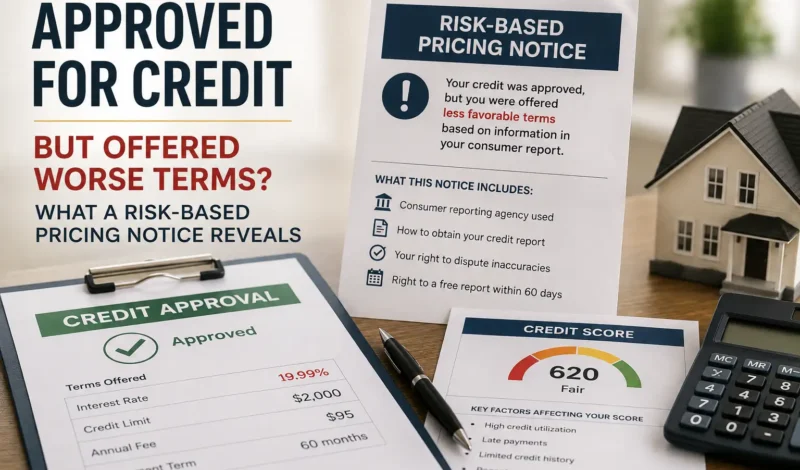

Being approved for a loan or credit card does not necessarily mean you received the lender’s most favorable terms. If information in your consumer report contributed to a higher interest rate or other materially less favorable terms, you may receive a risk-based pricing notice explaining that your credit report affected the offer. The notice can be especially important if inaccurate information may have made your credit appear riskier than it really is.
The Consumer Financial Protection Bureau describes risk-based pricing as offering less favorable credit terms, such as a higher interest rate, based on information in a consumer’s credit report or application. Federal rules require notices in specified circumstances when consumer-report information contributes to materially less favorable credit terms.
What a Risk-Based Pricing Notice Can Tell You About the Credit Terms You Received
A risk-based pricing notice is a disclosure associated with a credit decision in which you are approved but receive less favorable material terms because of information in a consumer report.
Under Regulation V, the general rule applies when a creditor:
- Uses a consumer report in connection with personal, family, or household credit; and
- Based in whole or in part on that report, provides credit on material terms that are materially less favorable than the most favorable terms available to a substantial proportion of its consumers.
For a consumer, the practical distinction is important.
You were not necessarily denied credit. Instead, credit was offered, but the price or other material terms reflected greater perceived credit risk.
For example, a lender might approve an auto loan while charging a higher interest rate than it offers consumers with stronger credit histories. The CFPB identifies a higher interest rate as a common example of risk-based pricing.
What Should the Risk-Based Pricing Notice Reveal?
A compliant general risk-based pricing notice contains much more than a statement that your credit affected the decision.
Current Regulation V requires the notice to explain that a consumer report contains information about your credit history and that the terms offered were set using information from a consumer report. It must also state that the terms offered may be less favorable than those offered to consumers with better credit histories.
The notice must also identify each consumer reporting agency whose report was used.
That can be particularly useful when you are trying to determine which credit report influenced the offer.
The notice should further tell you:
- To verify the accuracy of your consumer report
- That you have the right to dispute inaccurate information
- Which consumer reporting agency supplied the report
- How to obtain the report
- That federal law gives you the right to obtain that report without charge for 60 days after receiving the notice
Instead of treating the notice as routine paperwork, use it as a roadmap to the data behind the lender’s pricing decision.
What Does the Credit Score Section Tell You?

If the creditor used a credit score to set your material credit terms, additional information must generally appear in the notice.
The disclosure includes:
- The credit score used
- The possible range of scores under that scoring model
- Key factors that adversely affected the score
- The date the score was created
- The name of the consumer reporting agency or other person that supplied the score
The rule generally calls for up to four key factors that adversely affected the score, or up to five when the number of credit inquiries is one of the factors.
These factors can help you understand what influenced the score. However, they should not automatically be treated as a complete explanation of the lender’s underwriting decision.
A lender may use additional information when evaluating credit. The CFPB notes that lenders can consider factors such as income, outstanding debts, employment status, credit scores, and other information when establishing credit terms.
Is a Risk-Based Pricing Notice the Same as an Adverse Action Notice?
No. They address different credit outcomes.
An adverse action notice is generally associated with a negative credit decision, such as a credit denial based on information from a consumer report.
A risk-based pricing notice generally concerns a consumer who receives credit, but on materially less favorable terms because of consumer-report information.
The FTC summarizes the distinction clearly: when credit is denied based on a consumer report, adverse action requirements apply; when credit is granted on less favorable terms based on the report, risk-based pricing requirements may apply.
This is why someone can be approved for credit and still receive an important FCRA-related disclosure.
Why Should You Request the Credit Report Named in the Notice?
The most useful next step is often to examine the actual report that influenced the terms.
A risk-based pricing notice generally provides a 60-day right to obtain a free copy of the consumer report from the reporting agency identified in the notice.
Review that report for inaccuracies such as:
- Accounts belonging to another person
- Late payments you believe were reported incorrectly
- Incorrect balances
- Closed accounts reported as open
- Duplicate debts
- Incorrect credit limits
- Identity information that does not belong to you
- Accounts resulting from identity theft
The CFPB specifically identifies these types of errors as issues consumers should look for when reviewing credit reports.
If your report contains incorrect negative information, it is possible that the inaccurate information affected the credit score or report the lender considered.
But the presence of an error does not by itself prove exactly how much it changed your loan terms. That depends on the information used in the specific decision.
What Should You Do If You Find an Error?
Document the inaccurate item precisely.
Keep the risk-based pricing notice, the credit offer, the consumer report, and any records showing why the disputed information is incorrect.
The CFPB recommends disputing inaccurate or incomplete credit information with both:
- The consumer reporting company; and
- The company that furnished the information to the reporting company, such as a bank or credit card issuer.
For example, if your report incorrectly shows a late payment, provide enough information to identify that particular account and explain why the payment history is inaccurate.
A specific, documented dispute makes the factual issue clearer than simply saying your credit score is too low.
Does Receiving the Notice Mean the Lender Broke the Law?
No. Receiving a risk-based pricing notice does not itself mean the lender acted unlawfully or that your credit report contains an error.
Risk-based pricing is a recognized lending practice. The notice exists in part to give consumers transparency when consumer-report information contributes to less favorable credit terms. The notice becomes particularly important when the underlying report contains inaccurate information.
If an inaccurate account, payment status, balance, mixed file, or other reporting problem contributed to the data used in the credit decision, the accuracy of that information may need to be challenged.
Why Might You Receive a Different Credit Score Notice Instead?
Not every lender that uses risk-based pricing must send a document literally titled “Risk-Based Pricing Notice.”
Regulation V contains exceptions that allow creditors in certain situations to satisfy the risk-based pricing requirements by giving consumers specified credit score disclosures. One option allows a creditor to provide the required credit score disclosure to each consumer who requests certain types of credit rather than determining which individual consumers must receive the standard risk-based pricing notice.
So if you were offered worse terms but did not receive a notice with that exact title, review the credit score disclosures you received before assuming no required information was provided.
When Can a Credit Report Error Require Legal Review?
If the report used to price your credit contains inaccurate information, dispute the error and preserve the records showing what happened.
If inaccurate information remains after the dispute process, particularly when you can document that the report affected a real credit transaction, legal review may become appropriate.
At Justice Consumer Law, we assist consumers dealing with credit report errors and disputes under the Fair Credit Reporting Act. The firm identifies credit reporting errors and FCRA disputes as part of its consumer protection practice.
Whether a specific situation creates an FCRA claim depends on the facts, including what was inaccurate, who reported it, what you disputed, how the investigation was handled, and how the consumer report was used.
Frequently Asked Questions
Why did I receive a risk-based pricing notice if I was approved?
Because approval and pricing are different decisions. You may receive credit while still being offered materially less favorable terms based in whole or in part on information in your consumer report.
Does the notice tell me which credit bureau was used?
Yes. A general risk-based pricing notice must identify each consumer reporting agency that furnished a consumer report used in the credit decision.
Can I get the credit report for free?
A standard risk-based pricing notice must state that federal law gives you the right to obtain the identified report without charge for 60 days after receiving the notice.
Does a low credit score automatically mean my report is inaccurate?
No. A low score can result from accurate information. The purpose of reviewing your report is to determine whether the underlying information is accurate and complete.
What if the report contains a credit reporting error?
You can dispute inaccurate or incomplete information with the consumer reporting company and the furnisher that provided it.